Dans les bijoux chinois, rien n'est une décoration pour la décoration. Chaque motif a une signification qui s'est accumulée au fil des millénaires. Comprendre ce que l'on porte — ou ce que l'on offre — transforme la pièce de belle à significative. Ce guide couvre les symboles fondamentaux que vous rencontrerez dans les bijoux de la Nouvelle Esthétique Chinoise et les bijoux chinois traditionnels.

Phénix (凤凰 fènghuáng)
Le phénix est le symbole le plus important dans les bijoux féminins chinois. Contrairement au phénix occidental, qui est un oiseau unique renaissant de ses cendres, le fènghuáng chinois est souvent représenté en couple — un mâle, une femelle — et incarne la grâce féminine, la haute vertu et la transformation. Il est associé au sud, au feu, et à l'avènement d'une nouvelle ère.
Dans la joaillerie, le phénix apparaît le plus souvent dans les parures de mariée, les épingles à cheveux et les pendentifs imposants. Porter des bijoux à motif de phénix est synonyme d'élégance et de force — une femme qui a pleinement pris possession de son pouvoir.
Lotus (莲花 lián huā)
Le lotus est le symbole bouddhiste de la pureté spirituelle : il pousse dans des eaux boueuses mais fleurit propre, intouché par les circonstances de son origine. Dans la pensée confucéenne, il représente également l'intégrité morale — une personne qui maintient ses valeurs quelles que soient ses circonstances.
En joaillerie, les motifs de lotus sont parmi les plus polyvalents. Un pendentif lotus s'adapte aux contextes décontractés, professionnels et formels. C'est l'un des symboles les plus appropriés pour offrir un cadeau car il véhicule une signification largement positive — pureté, grâce et nouveaux départs — sans exiger que le destinataire soit bouddhiste.
Jade (玉 yù)
Le jade est moins un symbole qu'une philosophie matérialisée. Le savant confucéen Xu Shen a identifié cinq vertus dans le jade : la bienveillance (sa chaleur douce), la sagesse (la clarté de sa tonalité quand il est frappé), le courage (il peut être brisé mais non tordu), la justice (il a des bords tranchants mais ne coupe pas), et la pureté (il est beau sans artifice).
Dans la pensée chinoise, porter du jade était une façon d'aspirer à ces qualités. « Un gentilhomme ne se sépare jamais de son jade » — ce principe confucéen signifiait que le jade était porté constamment, et non réservé aux occasions. Les bijoux de la Nouvelle Esthétique Chinoise honorent cela en utilisant le jade et des formes qui y font référence pour des pièces conçues pour être portées au quotidien.
Volutes de Nuages (云纹 yún wén)
La volute de nuages est l'un des plus anciens motifs des arts décoratifs chinois, apparaissant sur des vases en bronze de la dynastie Shang (1600-1046 av. J.-C.). Les nuages dans le symbolisme chinois représentent la bonne fortune, la bénédiction céleste et la transcendance — le mouvement entre le terrestre et le divin.
Dans les bijoux de la Nouvelle Esthétique Chinoise, les motifs de nuages apparaissent sous forme de lignes fluides et organiques. Ils sont suffisamment subtils pour que quelqu'un qui n'est pas familier avec le symbolisme chinois y voie de gracieuses courbes ; quelqu'un qui connaît la tradition y reconnaîtra la référence plus profonde.
Poisson (鱼 yú)
Le poisson est un élément essentiel du symbolisme du Nouvel An chinois car le mot pour poisson (yú) est un homophone pour "abondance" (余). Les paires de poissons représentent l'harmonie conjugale et sont un motif courant dans les bijoux de mariage et les cadeaux du Nouvel An chinois.
Dans les bijoux, les motifs de poisson ont tendance à être décoratifs : pendentifs suspendus, petites formes sculptées serties d'or. Ils sont particulièrement appropriés pour les cadeaux de fin d'année et de la fête du printemps.
Fleur de Prunier (梅花 méi huā)
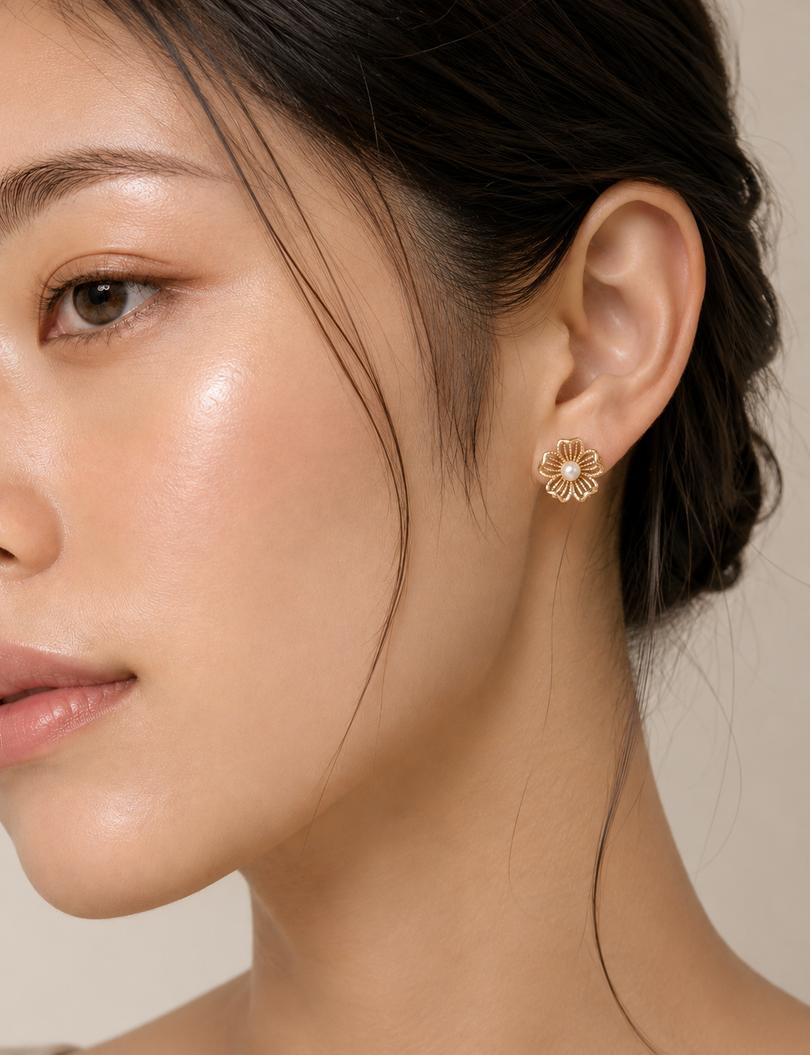
La fleur de prunier s'épanouit à la fin de l'hiver, souvent alors que la neige est encore présente. Elle représente la persévérance, l'espoir et le renouveau — la capacité à prospérer dans des conditions difficiles. C'est l'un des "Quatre Gentilshommes" de l'art chinois, aux côtés de l'orchidée, du bambou et du chrysanthème.
En joaillerie, la fleur de prunier a cinq pétales, chacun associé à l'une des cinq bénédictions : longévité, richesse, santé, vertu et mort naturelle. Offrir un bijou en fleur de prunier est considéré comme profondément propice.
Double Bonheur (囍 xǐ)
Le caractère 囍 est composé de deux caractères de bonheur (喜) joints ensemble. C'est le symbole le plus reconnaissable de la culture nuptiale chinoise. Dans les bijoux, il apparaît le plus souvent sous forme de pendentif et est presque toujours offert dans un contexte de mariage. Il n'est pas approprié comme cadeau général — réservez-le aux fiançailles, aux mariages et aux anniversaires importants.
Nœud (中国结 zhōngguó jié)
Le nœud chinois est une forme d'art décoratif avec plus de 1 500 ans d'histoire. Différentes formes de nœuds ont différentes significations : le nœud à double pièce représente la prospérité, le nœud porte-bonheur véhicule une énergie positive générale, et le nœud mystique (nœud sans fin) représente l'amour et la connexion éternels. Dans les bijoux, les éléments en or ou en cordon de soie noués sont une référence directe à cette tradition.
Bambou (竹 zhú)
Le bambou est l'un des symboles de longévité — il reste vert toute l'année — et représente la droiture, la flexibilité et la résilience. Dans les bijoux de la Nouvelle Esthétique Chinoise, le bambou apparaît comme un motif structurel : anneaux de bague aux formes segmentées, boucles d'oreilles avec des pendants allongés et articulés. Il est particulièrement adapté comme cadeau pour quelqu'un qui traverse un changement de vie majeur.
Comment choisir en fonction de la signification
| Symbole | Signification | Idéal pour |
|---|---|---|
| Phénix | Pouvoir féminin, transformation | Étapes importantes, mariage, achat personnel |
| Lotus | Pureté, grâce, nouveaux départs | Presque toutes les occasions, cadeau universel |
| Jade | Cinq vertus, aspiration morale quotidienne | Usage quotidien, pièce personnelle significative |
| Volute de nuages | Bonne fortune, bénédiction | Nouveaux départs, étapes professionnelles |
| Poisson (paire) | Abondance, harmonie | Cadeaux du Nouvel An Chinois, mariages |
| Fleur de prunier | Persévérance, cinq bénédictions | Cadeaux d'encouragement, hiver/Nouvel An Chinois |
| Double bonheur | Joie conjugale | Mariages et fiançailles uniquement |
| Nœud | Connexion, prospérité | Cadeaux d'amitié, étapes de partenariat |
| Bambou | Résilience, longévité | Transitions, remises de diplômes, encouragement |
Voir : Bijoux de la Nouvelle Esthétique Chinoise : Le guide complet de 新中式 (2026)